The Hidden Duty of Care: Your Complete Guide to Automated Gate Safety and Law
Written by Facility Servicing Group Ltd., 10th April 2026 - 5 min read
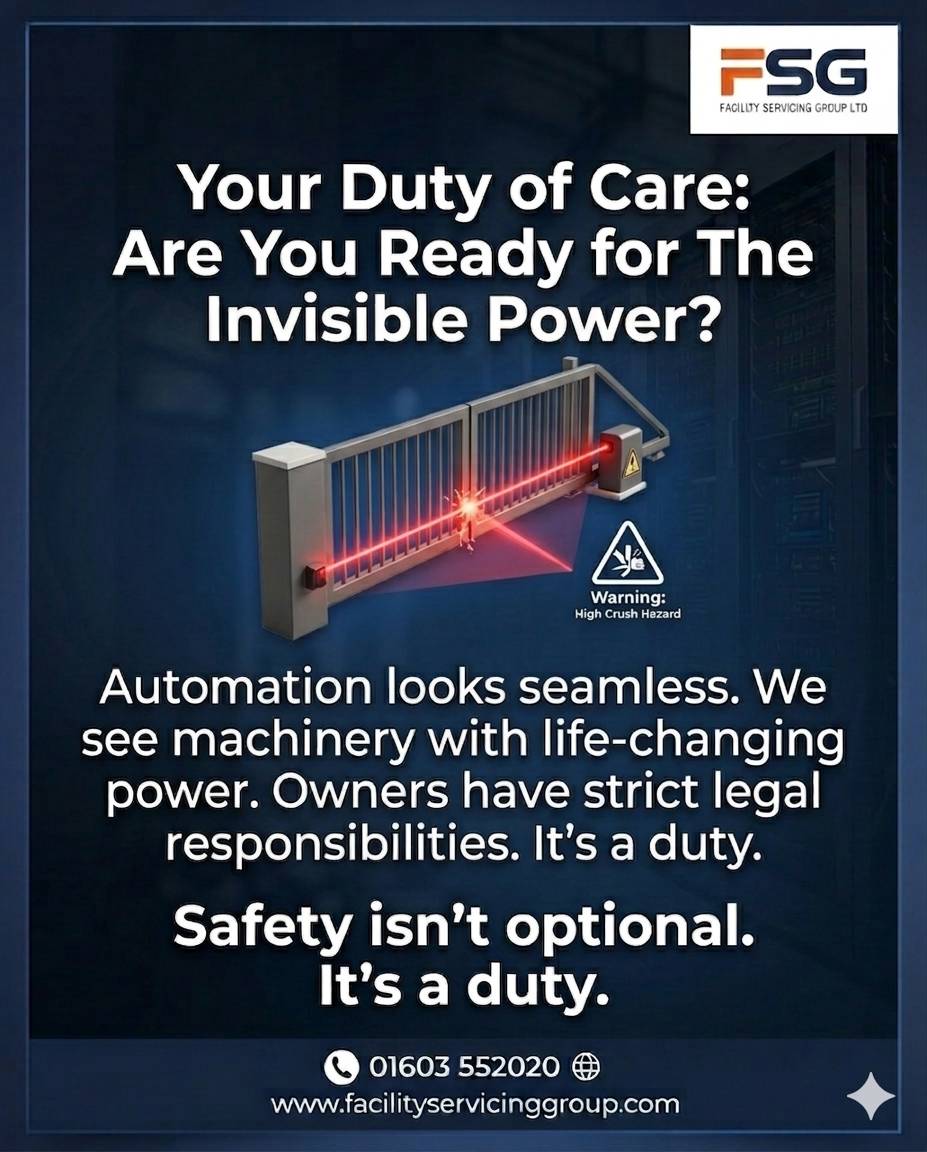
❝ Safety isn't a business cost—it’s an investment in your peace of mind and the protection of everyone who enters your site.
Introduction
1. The Legal Reality: Ignorance is No Defense
Automated gates fall under some of the strictest safety regulations in the country. If a gate causes injury to a visitor, staff member, or the public, "I didn't know" will not hold up in court. Compliance is your primary shield against immediate and serious liability.
Key regulations include:
- Supply of Machinery (Safety) Regulations: Governing the installation and "placing on the market" of gate systems.
- Health & Safety at Work Act: Protecting employees and the public on business premises.
- BS EN 12453 & BS EN 12635 Standards: The technical benchmarks for safe gate use and maintenance.
- DHF TS 013: The industry-standard Code of Practice for safety.
2. Identifying the "Big Four" Hazards
- Crushing: Being trapped between the moving gate and a fixed object (like a pillar or wall).
- Shearing: Limbs or fingers getting caught in moving parts or "scissor" points.
- Impact: Being struck by the sheer weight and momentum of a moving gate leaf.
- Drawing-in: Being pulled into the mechanism or fence line as the gate retracts.
3. Maintenance: The Missing Link in Compliance
The number one cause of gate accidents is neglect. A system that is safe on the day of installation can become dangerous within months if a sensor fails or a hinge weakens.
To remain both safe and legally compliant, we recommend the following service intervals:
- Commercial & High-Use Sites: Professional inspection and force-testing every 6 months.
- Domestic & Low-Use Sites: Inspection every 12 months (or 6-monthly for older systems).
A professional maintenance visit isn't just a "grease and oil" change; it includes testing safety "edges," checking photo-cells, and verifying that the motor's force-limiters are calibrated to stop the gate upon contact. If the safety devices fail, the gate fails.
4. Your Ultimate 6-Step Safety Checklist
- [ ] Know the History: Maintain a file of who installed the system and when.
- [ ] Schedule the Service: Don't wait for a breakdown to call an engineer. Preventative maintenance saves lives and money.
- [ ] Test Regularly: Conduct your own visual checks. Do the sensors stop the gate as intended?
- [ ] Document Everything: Keep a physical or digital logbook of all tests, repairs, and risk assessments.
- [ ] Never Ignore Faults: If a gate makes an unusual sound or moves erratically, isolate the power immediately and call a pro.
- [ ] Use Qualified Professionals: Ensure your engineers are specifically trained in gate machinery and UK safety standards.
Secure Your Peace of Mind
Is your gate safety audit up to date? Facility Servicing Group (FSG) provides expert risk assessments and maintenance for automated systems across Norfolk and Norwich.
Contact us today to book a safety inspection:
📞 Call: 01603 552020
🌐 Visit: www.facilityservicinggroup.com



Facility Servicing Group Ltd provides comprehensive protection for properties across the UK. As a trusted system and service provider, we serve corporate, commercial, and residential clients with expert fire alarm installation, access control, CCTV, property maintenance, security gates / barriers, and intruder alarms throughout East Anglia.
Contact Us
- support@facilityservicinggroup.com
- 01603 552020
- Unit 5,
Woodland Park Industrial Estate,
Shortthorn Rd, Norwich,
Norfolk, NR10 5NU
©Facility Servicing Group Ltd 2026, All rights reserved.
Company Registration Number 13654497. Registered in England.
Registered Office: Unit 7 Beech Avenue, Taverham Norwich Norfolk NR8 6HW.